I review a lot of AI generated code.
Here’s what it looks like:
    line: &str,
    width: usize,
    scopes: &[HunkScopes],
    scope_expanded: bool,
) -> Vec<Line<'static>> {
    if let Some(content) = line.strip_prefix('+').filter(|_| !line.starts_with("+++")) {
        return vec![syntax_diff_line(content, DIFF_ADDED_BG, &entry.path, width)];
    // ...
                .find(|s| s.hunk_new_start == new_start)
                .map(|s| s.ancestors.as_slice())
        });
        return render_hunk_separator(line, &entry.path, width, ancestors);
        return render_hunk_separator(line, &entry.path, width, ancestors, scope_expanded);
    }

    vec![Line::from(Span::raw(fit_line(line, width)))]
What is even going on?
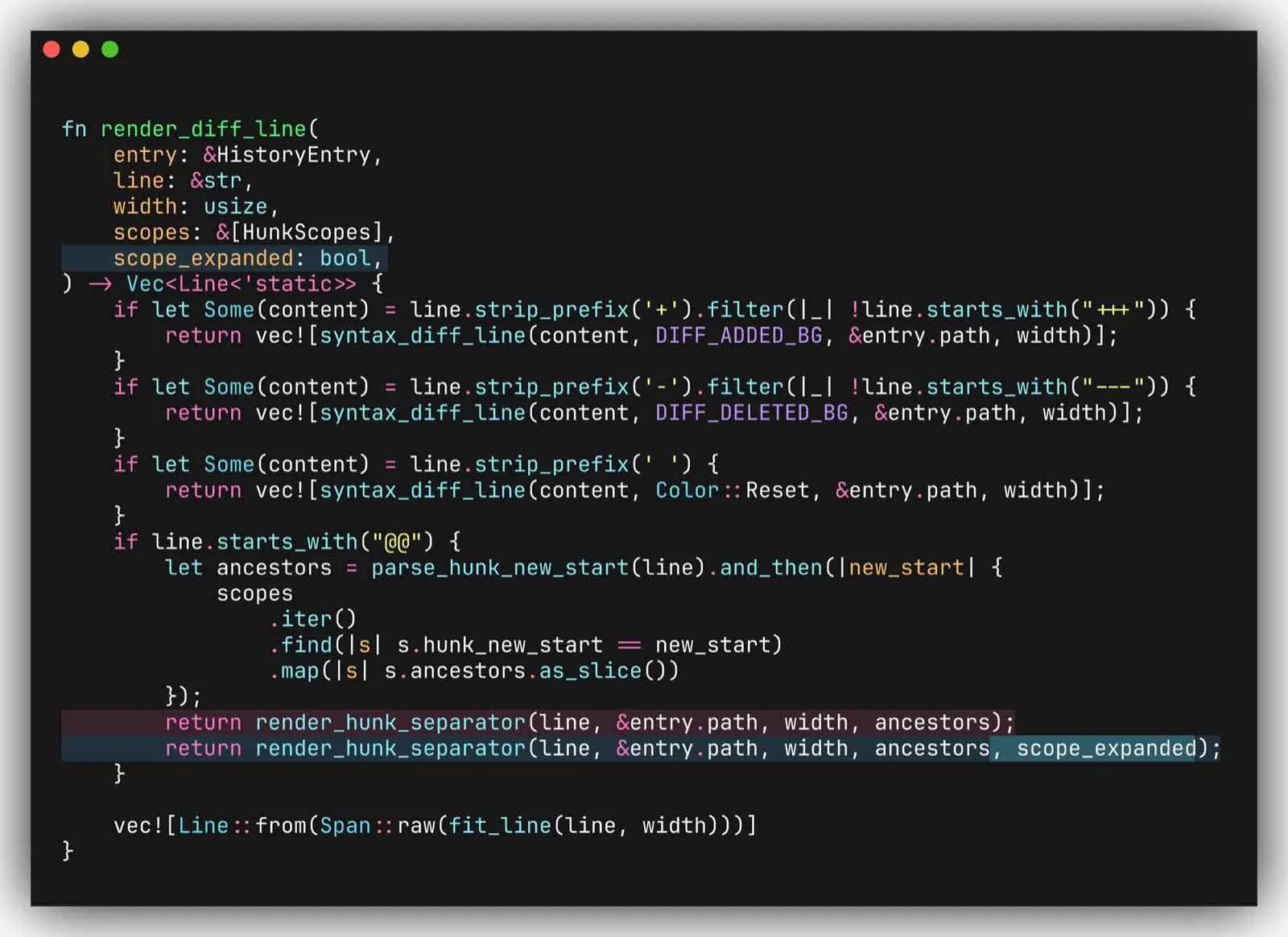
Try this version instead:
fn render_diff_line(
    entry: &HistoryEntry,
    line: &str,
    width: usize,
    scopes: &[HunkScopes],
    scope_expanded: bool,
) -> Vec<Line<'static>> {
    if let Some(content) = line.strip_prefix('+').filter(|_| !line.starts_with("+++")) {
        return vec![syntax_diff_line(content, DIFF_ADDED_BG, &entry.path, width)];
    }
    if let Some(content) = line.strip_prefix('-').filter(|_| !line.starts_with("---")) {
        return vec![syntax_diff_line(
            content,
            DIFF_DELETED_BG,
            &entry.path,
            width,
        )];
    }
    if let Some(content) = line.strip_prefix(' ') {
        return vec![syntax_diff_line(content, Color::Reset, &entry.path, width)];
    }
    if line.starts_with("@@") {
        let ancestors = parse_hunk_new_start(line).and_then(|new_start| {
            scopes
                .iter()
                .find(|s| s.hunk_new_start == new_start)
                .map(|s| s.ancestors.as_slice())
        });
        return render_hunk_separator(line, &entry.path, width, ancestors);
        return render_hunk_separator(line, &entry.path, width, ancestors, scope_expanded);
    }

    vec![Line::from(Span::raw(fit_line(line, width)))]
}
This shows the entire function, and it’s easy to see what changed: a new scope_expanded argument is added to the signature and passed through to render_hunk_separator. Easy to see in this diff. It also shows the entire function, which allows me to keep learning about the codebase since I don’t literally type the code anymore.
Here is another example:
    entry_indices: Vec<usize>,
    diff_scroll: usize,
    diff_cache: Option<DiffCache>,
    show_expanded: bool,
}

    // ...
            entry_indices: vec![0; trace_count],
            diff_scroll: 0,
            diff_cache: None,
            show_expanded: true,
        }
    }
You can see a field is added and initialized, but it doesn’t even show to what. Here’s what I want to see:
struct AppState {
    focus: Focus,
    trace_index: usize,
    entry_indices: Vec<usize>,
    diff_scroll: usize,
    diff_cache: Option<DiffCache>,
    show_expanded: bool,
}
fn new(trace_count: usize) -> Self {
Self {
focus: Focus::Entries,
trace_index: 0,
entry_indices: vec![0; trace_count],
diff_scroll: 0,
diff_cache: None,
show_expanded: true,
}
}This is possible using git diff -W, which can then be easily piped into delta. There’s also difftastic which uses tree-sitter for diffing but it’s limited to controlling diff context by number of lines.
What if we build something?